“The structuring of the data in these systems is a historical continuation of this white, Eurocentric, colonial, patriarchal fantasy, which assumes that the data floats. They float free from their origins, they are stripped from our bodies, from our history, and therefore they are free to navigate the world like a neutral currency, a universal currency. […] If we want to see the data structured from a feminist perspective, we have to fight for the democratization of the discussion.
– Paz Peña. Decolonizing the Internet’s Structured Data report.
2026 marks the 9th edition of the #VisibleWikiWomen campaign. One year away from celebrating the 10th campaign, in 2027!
Since its inception, the #VisibleWikiWomen campaign has actively challenged the white, Western, cisgender, able-bodied hegemony predominant in digital knowledge archives by bringing over 23,000 images to Wikimedia Commons, the Wikimedia public repository for free, high-quality media. This collective effort has sought to centre Black, Brown, Indigenous, trans women and non-binary people across diverse professions, geographies, and contexts of resistance.
The #VisibleWikiWomen images refuse singular narratives of who counts as “notable” or “worthy” of documentation. They honour women in all their glorious plurality, from sports to medicine to research, agriculture, and feminist organising. But more importantly, they document the everyday brilliance and labour often rendered invisible by dominant knowledge systems.
The campaign has deliberately celebrated womxn, trans, and non-binary people who have embodied feminist values to resist and dismantle patriarchy, capitalism, racism, colonialism, ableism, and other interlocking systems of oppression throughout history. The images also resist Western beauty standards and normative body politics by celebrating the diversity of our body sizes, shapes, abilities, and identities. Communities—not just individuals—are centred and honoured.

The issue remains… and evolves
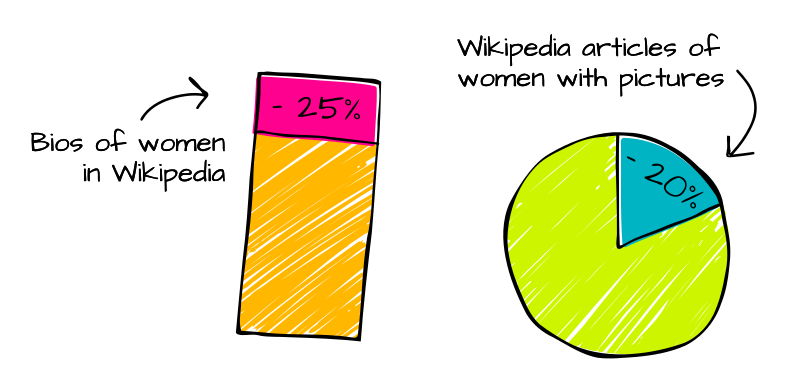
Women’s knowledge and contributions to the world are invisible in many ways. When we look at women’s invisibility online, Wikipedia is a good proxy to explain why this is such a critical issue. Less than ¼ of Wikipedia biographies represent women. Many biographies of important and influential women don’t exist or are incomplete.
More often than not, women’s biographies don’t have images. We estimate that less than 20% of Wikipedia articles about important women have pictures. Only 21% of the images that depict human beings on Wikimedia Commons represent women (according to https://humaniki.wmcloud.org).
When women’s faces are missing from Wikipedia, that invisibility spreads. Around 15 billion people read Wikipedia every month, and among the top 10 most visited websites in the world, it is the only non-profit one. At a time when web searches are increasingly driven by AI, Wikipedia is one of the sources most frequently cited by chatbots, while continuing to provide human-created and community fact-checked information. In other words, gaps on Wikipedia have a big impact on the broader internet.
Visibility gaps on Wikipedia and the broader internet widen even further when women are black, brown, trans, disabled, indigenous, not thin, or exist at the intersections of those multiple oppressions and vulnerabilities.
Theme of the Year: Whose Data Tells Our Stories? Resisting and reshaping data narratives.
“..the politics of images can no longer be separated from the infrastructures that produce them. “Data” and “content” are not abstract, frictionless entities; they are the outcome of labour, extraction and energy use.
– Kira Xonorica. On centring the human
Structured data –the small pieces of information that translate human data into a machine-readable form– is the backbone of much of today’s digital infrastructure, like “artificial intelligence” systems, search engines, knowledge graphs, and more. Its design directly affects which knowledge is visible, searchable, and usable online. Structured data however, isn’t only a technical artifact; epistemology and knowledge systems are at its heart. We acknowledge that hegemonic data narratives often erase and invisibilize the plural knowledges of the Global Majority world we inhabit.
Just as the sources cited in Wikipedia are as important as the information itself, structured data – descriptions and data annotations– are as crucial as the images added to Wikimedia Commons. And the VisibleWikiWomen campaign lives on Wikimedia Commons, the big multimedia library that hosts all Wikipedia images, and much more.
So this is not just an issue of our campaign, but it is primarily a Wikimedia Commons challenge. This Wikimedia platform contains more than 100 million openly licensed images. Still, only 15% have structured “depicts” annotations linked to Wikidata –the free knowledge base that connects all Wikimedia projects and many third-party applications and services. Depictions and descriptions are important signals for humans and machines alike about the content of an image. Adding structured data is important because it makes these images far more valuable, improving search, knowledge management, machine learning, and multimodal applications.
It is against this background that the 2026 VisibleWikiWomen campaign builds on the work we have been doing since 2021 when over 40 participants from around the world were invited to the conversation Decolonizing the Internet’s Structured Data, leading up to WikidataCon that year; the 2023 Deep diving into Decolonizing Structured Data learning circle at Wikimania in Singapore; and The #VisibleWikiWomen Feminist Data Soiree in 2025 –at Wikimania Nairobi– when we gather with a group of womxn, non-binary people, and allies to understand, reflect, talk, and do hands-on work around structured data.
Through this journey, we have learned that data is never neutral. It reflects whose perspectives are documented, whose stories are told, and whose images are visible or kept hidden. We remain cognizant that the images’ depictions and descriptions are as important as the images themselves, and for the 2026 campaign, we ask two important questions:
- Does the structured data tell the plural stories of the +23000 images that reside in the VisibleWikiWomen campaign collections over the last few years?
- Whose Data Tells Our Stories?
When womxn’s images lack proper documentation, our stories remain invisible in the digital systems that increasingly shape what the world knows and values. But we are also at risk of being misrepresented and exploited to perpetuate patriarchal and racialised narratives, suppressing our bodily plurality. Adding well-documented structured data to images isn’t a technical fix to make women’s contributions searchable and findable —it’s an act of resistance in times of centralised and opaque AI systems.
We invite you to join us not only to resist, but also to reshape and build structured data systems where our stories aren’t just visible, but properly named and valued, making our body and knowledge plurality impossible to ignore.
Our goal for 2026
The 2026 campaign is both an honoring of the labor and vision of our partners, allies, friends, and comrades in the revolution for our collective freedom, with whom we have built this campaign for nine editions, and also an invitation to strengthen this work by creating proper descriptions and captions, adding structured data to the images, and creating and improving items on Wikidata for images already in the #VisibleWikiWomen collections.
Our goal for this 9th edition of #VisibleWikiWomen is to bring 3000 new images of women and non-binary individuals to Wikimedia Commons, and to add structured data –linking existing or newly created Wikidata items– to at least 2000 images of the 23,000 that already exist within the VisibleWikiWomen category. Our focus is on increasing the usability and visibility of images of Black, Brown, Indigenous, Trans women and Non-Binary people that have already been uploaded as part of the #VisibleWikiWomxn campaign.
To reach this goal, we invite you, women’s and feminist organizations, culture and memory institutions, Wikipedia editors, user groups, chapters, and anyone who would like to give the plurality of women and non-binary people the visibility and acknowledgement they deserve. We are excited to collaborate with previous years’ friends, allies, and co-conspirators again as we welcome new partners from around the world.
Key moments of 2026
#VisibleWikiWomen is now a yearly campaign that starts in June. Certain celebrations and commemorations of the year can work as special moments to engage. We want to highlight the following key moments for our communities throughout the year:
- June: LGBTQIA+ Pride Month
- July 21: International Afro-descendant Women’s Day
- 5 September: International Indigenous Women’s Day
- 28 September: International Safe Abortion Day
- October: Black History Month [UK, Ireland, The Netherlands]
- 25 November to 10 December: 16 Days of Activism against Gender-based Violence
- And more…
How to participate
You can join the #VisibleWikiWomen campaign all year long, by gathering and uploading quality images in the public domain, or under free license, to Wikimedia Commons under the VisibleWikiWomen category. These images can be photographs or drawings of women, as well as images of their work, with proper consent.
Besides uploading images to Commons, you can also participate in the campaign by:
- Hosting or attending local events in your communities where photos can be taken or uploaded
- Releasing your existing photos of women and non binary people under free licenses
- Creating illustrations and drawings
- Promoting and publicizing this project by spreading the word about it and using the hashtags #VisibleWikiWomen, #VisibleWikiWomxn, #WomenofColors, on Facebook, X, and Instagram.
- Co-organizing and hosting an online event with Whose Knowledge? to bring the campaign to your local communities
- Creating a feminist corner at your public events, by installing a #VisibleWikiWomen photobooth.
And probably so much more! We’d love to see you come up with new ideas that make sense for you and your communities.
If you need extra support for participating in the campaign, please email us at visiblewikiwomen[at]whoseknowledge[dot]org.
How to get involved?
Content

‣ Help make our campaign multi-lingual by translating our Meta page, resources kit, and the campaign pages of our website into different languages.
‣ Make lists of Wikipedia women biographies without images (by country, by occupation, by century, by activity) to raise awareness of the gender visual gap and create interesting challenges for participants.
‣ Write a new Wikipedia article inspired by an “orphan” women portrait (an image without an article) and use that image to illustrate it.
Spread the word

‣ Curate and share: select images you love, and optionally mix them with inspiring texts and art, and just share it with the hashtag #VisibleWikiWomen #VisibleWikiWomxn, #WomenofColors.
‣ Collaborative covering: if you are a journalist, a blogger, a podcaster, or you just like to spread ideas online, you can create a piece of content about the campaign.
‣ Find all the materials you need for sharing the campaign in our social media graphics kit.
Support the campaign

‣ If you are a feminist organization, cultural and memory institution, media or other potential partner organization, become an institutional partner
‣ If you are an individual connected to potential partners (like the ones mentioned above), please introduce them to the campaign!
If you are connected with potential funders who may be able to fund and support this campaign, please bring them to the campaign!
‣ If you want to volunteer to support this year’s campaign, drop us a line at visiblewikiwomen[at]whoseknowledge[dot]org. There’s always room to welcome new allies!
‣ If you would like to financially support this year’s campaign, click here:

What we’ve done so far
In 2018, we launched the VisibleWikiWomen pilot edition, followed by seven other successful campaigns in 2019, 2020, 2021, 2022, 2023, 2024 and 2025.
In 2025, the 8th #VisibleWikiWomxn campaign ran under the theme of “It takes a village, Finding, Strengthening and Sustaining Feminist Community.” By working with this theme, we sought to honour the repetitive and rhythmic work of relationship building in community, while honouring the collective labour required for a community to grow, change or emerge. In a world marked by deepening divisions, we invited participants and organisers to honour Feminist Community as a means of resistance, and to stay rooted in our collective power.
Some highlights from 2025 are:
In March 2025, generations of feminists from all over the world gathered in New York City for the 69th session of the Commission on the Status of Women (CSW69) and to reflect, commemorate, and celebrate 30 years of the Beijing Platform for Action. In this link you can access to the pictures of some of the women and non-binary folks at CSW69, especially those from the Global Majority. They were taken in meetings, on the streets, on panels, and everywhere in between to visibilise and document a historical moment for the feminist movement. Some of the people were in Beijing in 1995.
The #VisibleWikiWomen Feminist Data Soiree, held on August 5, 2025, in Nairobi, Kenya, brought together twenty-five diverse and intergenerational participants from across the Global Majority with representation from Africa, Latin America, and Asia.
As part of the global 16 Days of Activism Against Gender Based Violence, we launched #16DaysOfTranslation – an online translation campaign that worked with activists around the world to translate articles and critical information on gender based violence into more languages. At the start of the campaign, the Wikipedia article on online gender-based violence only existed in six languages (despite the 358 language versions of Wikipedia that exist). Contributors expanded the availability of reliable info in Arabic, Spanish, Portuguese, and Luganda. As part of this campaign, we also brought images for the femicide exhibition hosted by Usikimye in Kenya to the VisibleWikiWomen campaign, and we told the story in the blog post Feminist Action and Community Against Algorithmic Misogyny.
In the webinar Feminist Structured data: A Conversation with Art+Feminism and Whose Knowledge?, we discussed, with our partners of Art+Feminism, why feminist approaches to structured data matter, how Wikidata’s current gaps reflect broader inequities in knowledge production, the challenges of representation and capacity on Wikidata and the opportunities for collaboration between local and global communities.
Our partners & friends
-

- AfroCROWD

-
- Art + Feminism

-
- Association CLibre #CLibreTn

-
- Global Fund for Women

-
- Mujeres latinoamericanas en Wikimedia

-
- O Foundation

-
- Open Foundation West Africa #OFWAFRICA

-
- Black Lunch Table

-
- WikiDonne #WikiDonne

-
- Wikimedia Argentina

-
- Wikimedia Bolivia

-
- Wiki Movimento Brasil

-
- Wikimedia Israel #WikimediaIL

-
- Wikimedia Tunisie #WikimediaTN

-
- Wikimedia Uruguay

-
- Wikimujeres

-
- Women in Red

-
- AfroCROWD
-
- Amical Wikimedia

-
- Art + Feminism
-
- Association CLibre #CLibreTn
-
- Association for Women’s Rights in Development (AWID)

-
- Biblioteca Daniel Cosío Villegas (Mexico)

-
- Women and Memory Forum

-
- Global Fund for Women
-
- Global Voices

-
- International Association of Women’s Museums

-
- Mujeres latinoamericanas en Wikimedia
-
- O Foundation
-
- Open Foundation West Africa #OFWAFRICA
-
- Smithsonian National Portrait Gallery

-
- Syrian Female Journalist Network

-
- Techqueira

-
- Black Lunch Table
-
- WikiDonne #WikiDonne
-
- Wikimedia Argentina
-
- Wikimedia Bolivia
-
- Wiki Movimento Brasil
-
- Wikimedia DC

-
- Wikimedia Israel #WikimediaIL
-
- Wikimedia Nigeria

-
- Wikimedia Tunisie #WikimediaTN
-
- Wikimedia Uruguay
-
- Wikimujeres
-
- Women in Red
-
- Africa is a Country

-
- African Women’s Development and Communication Network (Kenya)

-
- AfroCROWD
-
- Amical Wikimedia
-
- Association for Progressive Communications

-
- Art + Feminism
-
- Association CLibre #CLibreTn
-
- Association for Women’s Rights in Development (AWID)
-
- Barbados Museum & Historical Society

-
- Biblioteca Daniel Cosío Villegas (Mexico)
-
- Development Alternatives with Women for a New Era

-
- Ennegreciendo Wikipedia

-
- Global Fund for Women
-
- Global Voices
-
- Gobierno de Entre Ríos (Argentina)

-
- International Association of Women’s Museums
-
- International Image Interoperability Framework Consortium

-
- International Women’s Day Wikipedia Edit-a-Thon 2020

-
- Mujeres latinoamericanas en Wikimedia
-
- O Foundation
-
- Periodicas

-
- Smithsonian National Portrait Gallery
-
- Syrian Female Journalist Network
-
- Techqueira
-
- Black Lunch Table
-
- WikiDonne #WikiDonne
-
- Wikimedia Argentina
-
- Wikimedia Bolivia
-
- Wiki Movimento Brasil
-
- Wikimedia DC
-
- Wikimedia Israel #WikimediaIL
-
- Wikimedia Nigeria
-
- Wikimedia Tunisie #WikimediaTN
-
- Wikimedia UK

-
- Wikimedia Uruguay
-
- Wikimujeres
-
- Women in Red
-
- World Pulse

-
- Association for Women’s Rights in Development (AWID)
-
- Lankelly Chase

-
- Wikimedia Argentina
-
- Wikimedia Uruguay
-
- Women in Red
-
- World Pulse
-
- African Women’s Development and Communication Network (Kenya)
-
- AfroCROWD

-
- Art + Feminism
-
- Association for Progressive Communications
-
- Association for Women’s Rights in Development (AWID)
-
- Black Lunch Table
-
- Campaña Alto Mujeres Trabajando

-
- Flickr Foundation

-
- Mozilla Foundation

-
- Take Back the Tech

-
- Wiki Movimento Brasil
-
- Wikimedia Argentina
-
- Wikimedia Uruguay
-
- Women in Red
-
- World Pulse
-
- 500 Women Scientists

-
- African Women’s Development and Communication Network (Kenya)
-
- AfroCROWD
-
- Art + Feminism
-
- Association for Progressive Communications
-
- Black Lunch Table
-
- Campaña Alto Mujeres Trabajando
-
- Flickr Foundation
-
- GALA Queer Archive

-
- Mais Teoria da História na Wiki
-
- Noircir Wikipédia

-
- Take Back the Tech
-
- Wiki Editoras Lx
-
- Wikimedia Foundation

-
- Wiki Movimento Brasil
-
- Wikimedia Argentina
-
- Wikimedia Uruguay
-
- African Women’s Development and Communication Network (Kenya)
-
- AfroCROWD
-
- Art + Feminism
-
- Association for Progressive Communications
-
- Black Lunch Table
-
- Campaña Alto Mujeres Trabajando
-
- Flickr Foundation
-
- GALA Queer Archive
-
- Mais Teoria da História na Wiki
-
- Noircir Wikipédia
-
- Take Back the Tech
-
- Wiki Editoras Lx
-
- Wikimedia Foundation
-
- Wiki Movimento Brasil
-
- Wikimedia Argentina
-
- Wikimedia Uruguay

-
- Association for Women’s Rights in Development (AWID)


-
- AfroCROWD
-
- Art + Feminism
-
- Association for Progressive Communications
-
- Black Lunch Table
-
- GALA Queer Archive
-
- Mais Teoria da História na Wiki
-
- Noircir Wikipédia
-
- Take Back the Tech
-
- Wiki Editoras Lx
-
- Wikimedia Foundation
-
- Wiki Movimento Brasil
-
- Wikimedia Argentina
-
- Wikimedia Uruguay
-
- Association for Women’s Rights in Development (AWID)


-
- AfroCROWD
-
- Art + Feminism
-
- Association for Progressive Communications
-
- Black Lunch Table
-
- GALA Queer Archive
-
- Mais Teoria da História na Wiki
-
- Noircir Wikipédia
-
- Take Back the Tech
-
- Wiki Editoras Lx
-
- Wikimedia Foundation
-
- Wiki Movimento Brasil
-
- Wikimedia Argentina
-
- Wikimedia Uruguay
-
- Association for Women’s Rights in Development (AWID)
Resources
If you have never uploaded images to Wikipedia or Wikimedia Commons before, don’t worry, we have you covered! We created this #VisibleWikiWomen resource kit, where you will find instructions and practical advice on how to navigate the Wikiverse, especially how to use Wikimedia Commons.
The resource How to upload images to make women visible on Wikipedia and the Internet is particularly useful as it will guide you through the process of uploading images for this campaign.
Other related resources to help you are:
- Getting and giving consent for images on Wikipedia
- How to find images on the internet to illustrate Wikipedia
- Dos and Dont’s for adding images to Wikimedia Commons and Wikipedia
- How to create drawings for Wikipedia
- How to ask for image donations
- How to join VisibleWikiWomen as a campaign organizer in your local context
- Have a photographer present at edit-a-thons to photograph notable women with consent
- Guide for Cultural and Memory Institutions to make women more visible on Wikipedia
…and if you need inspiration, here are some lists of articles that are missing images of women on Wikipedia.
